


It’s not exaggerating to say that I’m happy.
In the last three years I broke free and started to live deliberately.
I don’t complain or blame others anymore.
I’ve done and achieved a lot of things I always wanted to. I’ve seen all my favorite bands live, I visited countries I always wanted to, I built the body I’ve never had, I started to write, I got promoted at work and got a raise, I dealt with all my mental and physical issues.
Today, I’m dancing across my apartment, laugh a lot, sleep well and look positively into the future.
But this wasn’t always the like that.
The whole foundation of everything I mentioned above goes back to one sentence I didn’t understand when I’ve heard for the first time.
Take responsibility for your life.
That is what people told me when I was 20 and complaining about my poor childhood, my parents, and feeling like a victim.
How could I do anything about how my parents behaved? - I asked.
I was simply there, I suffered, and now?
I had to live with the consequences. The only thing I could do was blame them for my shortcomings.
Then my girlfriend left me. She was so superficial, and I had done everything right.
What could I do? If she had been different, we would still be together.
And when the government finally did something about inflation, then I would have the money to go to the gym and travel the world.
But they only support the rich, so what could I do about that?
I literally lived my life like this. Leaned back and blamed everything and everyone for my own misery.
Taking responsibility wasn’t my strength but my creativity for creating excuses for everything was something I already mastered very early in my life.
As a result, I felt stuck and helpless for years until I understood what it actually means taking responsibility and how to take control over my life which led to something I could never imagine before, I broke free.
This might sound dramatic and honestly, it really felt epic.
Once you get into the right mindset, you feel unstoppable.
You think differently and ask different questions.
Instead of “Why me again,” “Why not,” or “Why them.” it becomes about “What can I do?” and “How can I move forward?”.
Taking responsibility sets you free and puts you in the position of control.
But then why are there so many people who live their whole life staying helpless and blaming?
Well, there is a good reason for that.
Blame Feels Good but Keeps You Stuck
People love complaining and blaming others because it is emotionally comfortable.
If the job is bad, the boss is the problem, not you.
If the relationship fails, the partner is the problem, not you.
If life feels unfair, the world is the problem, not you.
If money is short, the government is the problem, not you.
There are many problems, but they have nothing to do with you.
What a convenient situation.
But here is the important part you might not realize.
Blame protects your ego, yes, but it also removes your power.
If everything is someone else’s fault, nothing is under your control.
You are completely dependent on external circumstances.
Your life is controlled by luck, fate, chance, and powerful other people, but not by you.
It is the opposite of freedom. It is like being kept in a cage while someone else holds the key.
Helpless.
Many people operate in this helpless mode by default, without even noticing.
Let me give you an example I have heard countless times, one that will probably feel familiar.
Some people complain about their job for years. The work is meaningless, the money is not enough, and the boss is terrible.
When I listen to this, my problem-solving mind immediately asks:
How many job applications have you sent in the last 12 months?
Do you know what you would rather do instead of your current job?
When did you last learn a skill that could help you move forward?
The answer is usually that they do not even have a CV. They do not know how or where to apply for a new job.
By this point, they often already dislike me for asking and want to shut down the conversation quickly with something like:
“David, it is not as simple as you think.”
I show understanding, nod, and accept that they do not want to discuss it further.
The truth is, many people live their whole lives waiting for a miracle and blaming others for their situation while doing nothing that could change it.
They tell themselves the story that it’s not as simple as the situation of others.
Their problem is unique.
This comfort of blame feels good in the moment, but it keeps them stuck indefinitely.
Quick favor: If this resonates with you, I’d be grateful if you subscribed to Running Home. I share more stories like this about growth, awareness, and the messy journey back to yourself. It’s free, and it helps me keep writing honestly. Thank you. — David
Why Most People Avoid Responsibility at All Costs
If you accept responsibility, you cannot hide anymore.
It removes the excuses you have been using for years.
And yes, it can hurt at the beginning.
Let me give you an example from my personal life that hopefully helps you understand what taking responsibility really means and why it can be painful at first.
After my last relationship ended, I decided to seriously change my life and started asking the right questions.
One of the first questions I asked myself was:
Why did almost all my relationships end in a similar way to the last one?
Note: At this point, I was already at a different level than when I was 20. The question came from a place of reflection and honesty with myself.
Mark Manson once said:
“Between all the problems and difficulties you have experienced, there is one common factor, and that is you.”
I loved this. It helped me stop blaming my ex-girlfriends for my unsuccessful relationships and start asking the most feared question out loud:
What did I do wrong?
Then I sat down and typed a long list into a note on my phone of things I messed up:
I behaved jealously several times without reason, mostly because of my own insecurities.
I did not support her in the things she wanted me to because I decided they were silly. In reality, I was jealous of her hobbies, mostly because I did not have any of my own.
I reacted by withdrawing love when she did not do something the way I wanted. I used the same pattern my mother used when she treated me as a child.
When I wrote down these things I got a heart rush, got red and started sweating. But this honest moment changed the way how I looked at situations in my life because there was nothing between me and the truth anymore.
There could be other examples regarding your financial problems, job, friendships, parents, or health.
You might blame your job for a low wage for not being able to save money while constantly buying the newest iPhone and never trying to find a new job or learn new skills.
Or you might wish for a beautiful partner and blame others for being superficial, while you complain constantly, neglect hygiene, and never make an effort to improve yourself.
Being radically honest with yourself can be extremely humbling and it hurts at first.
But after you face the truth, admit that not the whole world is against you, and acknowledge your own baggage, something important happens.
You start taking responsibility.
Owning your past behaviors also means that you can act differently in the future.
You are no longer a victim but you are in control.
Why Responsibility is Valuable: Lessons from Literature and Philosophy
The idea that taking responsibility sets you free is not something I discovered alone. Thinkers, writers, and leaders across centuries have arrived at the same conclusion from completely different directions, which tells you something about how fundamental this is.
Psychology: Internal Locus of Control and Self-Determination
Research consistently shows that people who believe they can influence their own outcomes report higher wellbeing, resilience, and life satisfaction. Psychologists call this an internal locus of control. People on the opposite end of the spectrum, those who believe life simply happens to them, tend to feel more like victims and less capable of changing their situation. Self-Determination Theory adds another layer to this: autonomy is a core psychological need. You feel fulfilled when you act as the author of your own life rather than handing that authorship over to circumstances or other people.
Jocko Willink and Leif Babin: Extreme Ownership
In Extreme Ownership, Willink and Babin make the case that every outcome, success or failure, is ultimately your responsibility. Leaders who genuinely internalize this stop wasting energy on blame. They analyze what happened, adapt, and move. The argument runs deeper than leadership though. Discipline and accountability are not constraints on freedom, they are what create it.
Stoicism: The Dichotomy of Control
Epictetus divided life into two categories: what is within your control and what is not. Your actions, your attitude, your judgments, those are yours. Other people’s behavior, external events, outcomes, those are not. Suffering, according to the Stoics, comes largely from confusing the two. Responsibility starts exactly here: owning what is genuinely yours to own and releasing what never was.
Viktor Frankl: Choosing How You Respond
Man’s Search for Meaning is one of those books that is difficult to argue with. Frankl survived Nazi concentration camps and came out with a conclusion that has stayed with me since I first read it: the last human freedom is the choice of how you respond to any situation. If someone in those circumstances could hold onto that, the excuses most of us carry around start to feel a lot less solid.
My Take
My life changed significantly once I stopped waiting for external circumstances to improve and started owning everything I could. That does not mean I blame myself for things outside my control, it means I focus my energy on what I can actually do something about and let go of the rest. What followed was not just more productivity or better habits. It was a genuine sense of freedom. There are very few situations now where I hit a wall and feel completely helpless, because there is almost always something on my side I can adjust, try differently, or let go of entirely. That feeling of having options, even in difficult moments, is what freedom actually feels like to me.
A Framework for Taking Responsibility and Gaining Freedom
Enough theory.
The point of understanding why something works is to use it. What follows are the practical steps and examples that can help you actually start living this way rather than just finding it interesting.
Step 1: Identify What Is Truly Yours
This mental model helps you split your life into three categories so your brain stops wasting energy on the wrong things.
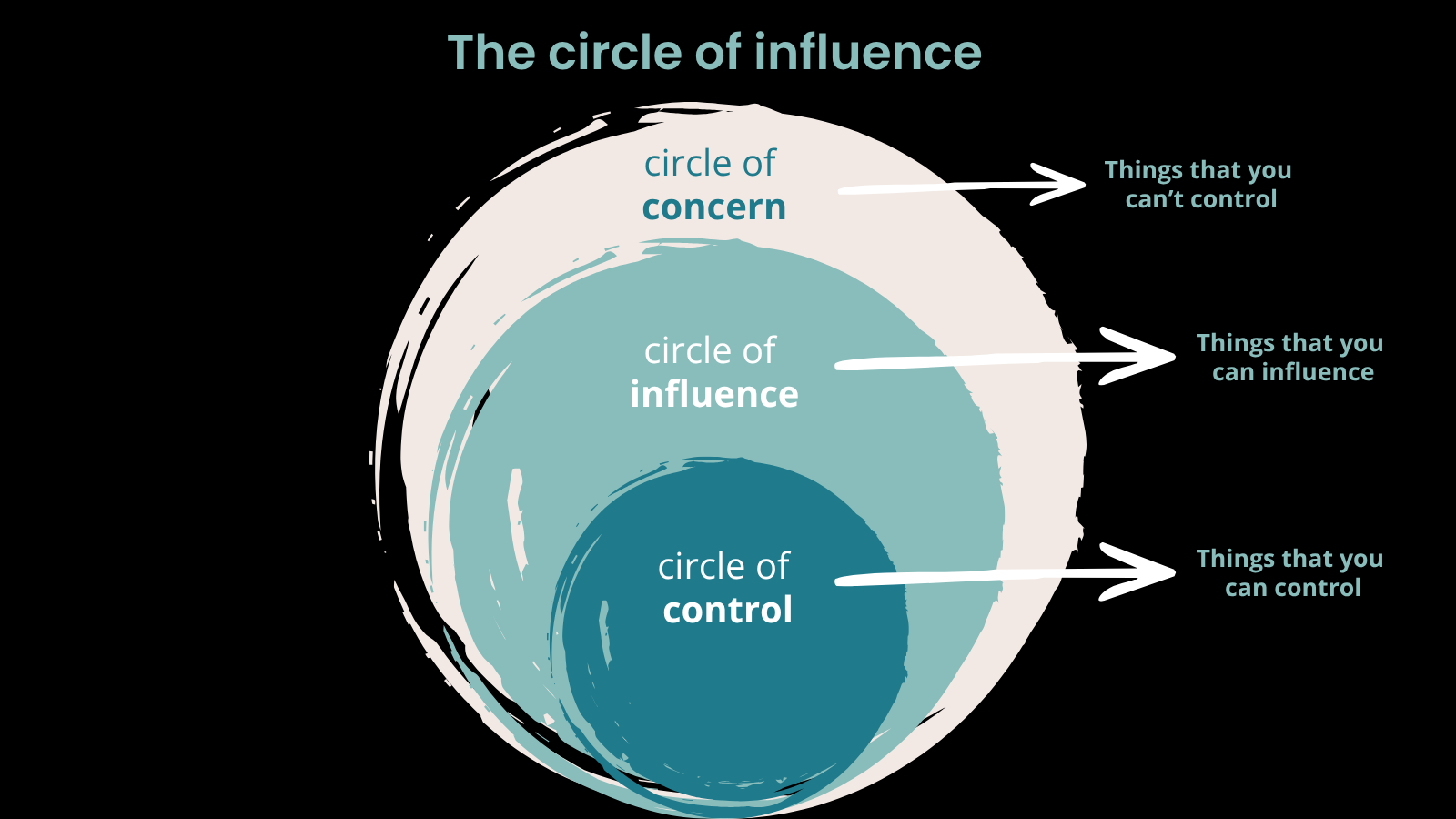
The Circle of Control
These are the things you directly control. This is where your responsibility truly lies.
How you prepare for important moments. Whether you show up on time, dress well, plan ahead, schedule your training, or prepare what you want to say. Before a date you can make sure you look presentable, smell good, arrive on time, and have a plan for the evening. Nobody else is responsible for that.
The effort you put into your work. Starting the task even when you do not feel like it, finishing what you committed to, improving your skills over time. When writing an article you can sit down, write a draft, edit it, and ask for feedback. That part is entirely yours.
How you treat other people. Listening attentively, speaking honestly, keeping your promises. In any conversation you can choose to be curious and respectful, even when the other person is not.
Your attitude when things go wrong. Staying constructive instead of looking for someone to blame. Choosing to learn from a mistake rather than defending yourself against it.
The Circle of Influence
These are things you cannot fully control but can meaningfully influence through your actions and preparation.
You cannot control whether someone feels chemistry on a date, but you can show up present and engaged. You cannot control whether readers love your article, but you can research well, write carefully, and edit thoroughly. You cannot control the final hiring decision, but you can prepare well, communicate clearly, and present your experience honestly.
Your effort matters here. The outcome is shared.
The Circle of Concern
These are the things you care about but cannot control or meaningfully influence. Other people’s opinions of you. The economy. Market conditions. The weather on race day. The past.
Most people spend the majority of their mental energy here. That is where the helplessness comes from.
A simple way to remember it: focus your energy in the Circle of Control, do your best in the Circle of Influence, and notice the Circle of Concern without letting it run your life.
Step 2: Radical Honesty
I already gave you a taste of what this looks like with my relationship example. The bad news is that it can be painful to go through. The good news is that once you lay everything out on the table there is nothing left to hide, and the next time you do this it will be significantly easier than the first. You also do not need to share any of it with anyone. This is between you and yourself.
The rule is simple. Every sentence starts with “I” and it ends the moment you start explaining why it was not really your fault. The words “but,” “because,” “since,” and “if only” are usually the signal that you are sliding back into excuse territory. Stop there.
There is one exception. “Because” is allowed when it points back toward you, your feelings, your patterns, your choices. The test is simple: does the “because” lead back to you or away from you? If it leads away, stop. If it leads back, keep going.
Being jealous in a relationship
Instead of: I was jealous because she went out a lot and gave me enough reasons.
Radical honesty version: I was jealous because I felt insecure and thought she would leave me for someone better.
The first “because” points outward toward her behavior. The second points inward toward your own insecurity. That is the difference. Her going out belongs to the Circle of Concern. Your jealousy and what is driving it belong to the Circle of Control.
Drinking despite your goals
Instead of: I drank last weekend because it was my friend’s birthday.
Radical honesty version: I drank even though I had committed to staying sober.
The birthday belongs to the Circle of Concern. The choice belongs to you.
Diet
Instead of: I ate the pizza because my coworkers brought it to the office.
Radical honesty version: I chose to eat the pizza even though I knew it did not fit my nutrition plan.
Other people offering food is not your responsibility. What you put in your body is.
Finances
Instead of: I cannot save because I do not make enough money.
Radical honesty version: I did not prioritize saving or look for ways to improve my financial habits.
Income level is partly outside your control. How you plan and use what you have is not.
You can do this for every area of your life where you are unsatisfied and have been telling yourself you have no control. In most cases you have more room than you think.
Step 3: Adopting the Mindset in Everyday Life
Once you have been through the first two steps you can start applying this awareness in real time.
The shift is simple: you stop asking “why is this happening to me” and start asking “what can I do about this.”
If your realization is: I did not prioritize saving money. The question becomes: How can I prioritize saving from now on?
If your realization is: I chose to eat the pizza despite my plan. The question becomes: How do I handle that situation differently next time?
If your realization is: My life feels boring because I never plan anything for myself. The question becomes: What could I plan for this weekend?
The Circle of Concern disappears from the equation. You focus entirely on what you can control and move straight to solutions. That one shift, from “why” to “how”, is what separates people who feel stuck from people who feel free.
This works like a muscle. The more you use it the more automatic it becomes. Today this is my default mode. When something in my life is not where I want it to be, I go straight to the how. I rarely waste energy on things outside my control, and the part of my life where I have genuine influence has expanded far beyond what I once thought possible.
You can get there too.
Step 4: Use AI as a Sparring Partner
After you have adopted the mindset of responsibility, AI can be an incredible tool to support you on the journey.
It helps not only to identify where your responsibility lies but also to ask the right questions about solutions and give you inspiration on how to approach them.
If you want to make your life more exciting because you realized you had been blaming the world for your boredom, tools like ChatGPT can give you a long list of options to bring novelty back into your life.
If you have admitted honestly that you have been avoiding your finances, AI can help you build a starting plan.
The key is to use it to look inward and move forward, not to outsource the thinking you need to do yourself.
Freedom Was Always Yours
Most people spend their lives waiting.
Waiting for the right moment, the right circumstances, the right person to finally make things easier.
What they do not realize is that the waiting is the cage.
Freedom is not something that happens to you when conditions improve.
It is something you build, decision by decision, by owning your life completely.
The mess, the failures, the patterns you are not proud of, and the next step forward.
When I was 20 and someone told me to take responsibility for my life I had no idea what that meant.
Now I do.
It meant stop waiting.
It meant that nobody was coming to save me, and that this was not a tragedy but the most liberating truth I had ever heard.
That truth is available to you too.
Thanks for sticking with me through this one. If you’re going through something similar, or have your own experience with this, drop a comment. I read every one. — David
Read More:


Hear hear! 👏🏽🙌🏽
You really nailed this. There’s something genuinely freeing in the way you frame responsibility. As a Greek, I grew up around these ideas, and reading Epictetus, it always comes back to that simple but powerful distinction: freedom begins the moment you see clearly what is within your control and what isn’t. Beautifully written.