

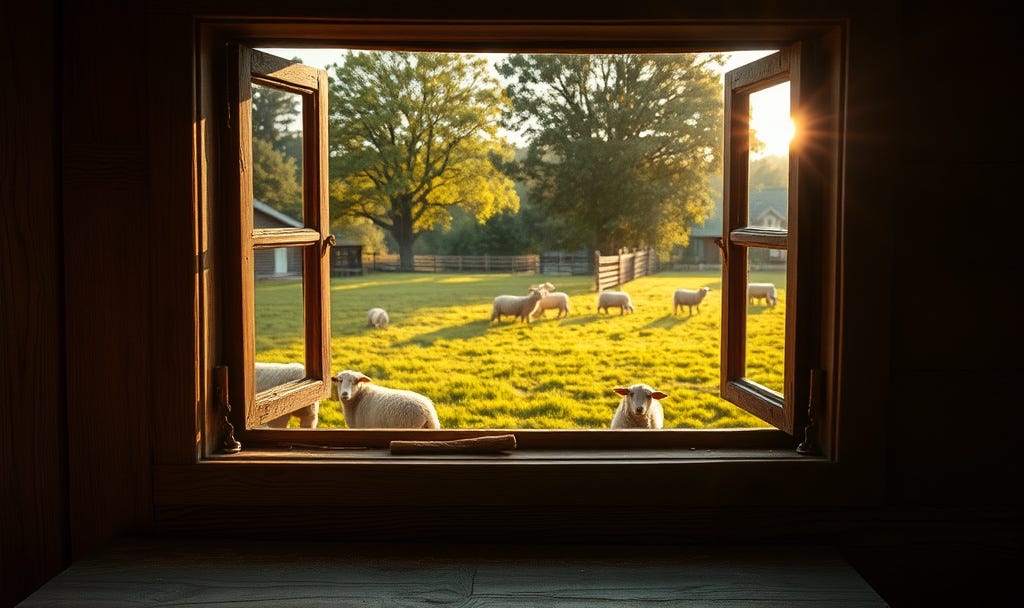
It’s morning, and after waking up, I head into the kitchen. The morning sun shines through the window and turns the kitchen into a warm, yellow-colored space. I make coffee and look out at my backyard. The grass is vivid green, and my sheep have already come out of the stable. I’m smiling, thinking about the day ahead of me.
No meetings. No computer. No cell phone or any kind of annoying nonsense work.
Just me and my farm.
I often have this fantasy.
Funnily enough, I’ve heard this from many people who work in similar roles. Office workers who get up in the morning and work 9 to 5.
They start their day with some kind of stand-up or Monday morning meeting.
They have titles like business intelligence manager, chief of staff, or growth marketing manager. Meetings after meetings.
The output is usually some kind of slides nobody will look at.
They create documentation nobody will read. They spend most of their time in meetings with others who do similar things with similar meaningless outputs.
One day after another.
These people, including me, often reach the moment where they think:
“I would love to work on my own farm.”
“I would like to work in a zoo with animals.”
“I would love to have a vineyard and produce delicious wine.”
“Something physical with my name on it. Something I can look at, give to other people so they can enjoy it.”
The absurdity of this fantasy is that none of these people have ever worked on a farm or done physical labor at all. They don’t know what it takes to run a farm or work in a zoo.
Still, the idea of a slow, non-digital life with visible output makes the fantasy extremely compelling.
This is a recurring fantasy. Usually after another meeting with managers where we define some kind of technical roadmap, create tickets for the backlog while knowing that all the ideas and plans will be obsolete tomorrow.
It feels meaningless.
It’s Rarely About the Farm
As you probably suspect, it’s not about farming.
It’s not a life vision people are heading toward with a well-thought-through strategy. It’s more like a signal that something is missing, something most humans want to feel in their life: meaning, being useful, producing something that stays and matters.
In those office jobs, people rarely have visible results.
Most of the work is abstract.
Sitting in meetings and talking through the same problem again and again.
Sending emails or setting up automations.
My days often end with the feeling of missing accomplishment, even if I feel mentally exhausted. When I ask myself what the outcome of today’s work was, I can barely define it.
Besides the lack of meaning, physical movement is also missing. I have back pain after sitting eight hours at my desk. My eyes are dry, but my body is completely unused. The accumulated stress works through my entire body. I always think I would implode if I didn’t do sports regularly.
The responsibility feels ridiculous. We talk about key performance indicators and objectives and key results (office workers know what that is).
But what are we really responsible for?
Numbers on a dashboard?
A project timeline?
Meanwhile, the farm fantasy offers responsibility for actual living beings.
Animals that need you. Plants that depend on you. Real consequences, not just missed deadlines.
Quick favor: If this resonates with you, I’d be grateful if you subscribed to Running Home. I share more stories like this about growth, awareness, and the messy journey back to yourself. It’s free, and it helps me keep writing honestly.
What’s Really Behind the Desire
When I dig deeper into this fantasy, it’s not actually about sheep or vegetables.
It’s about what those things represent.
Visible results instead of abstract work.
You plant a seed, and you see it grow.
You feed an animal, and it’s healthy.
You build a fence, and it stands there.
Compare that to: you attend a meeting, send an email, update a document, and nothing tangible exists. Your effort disappears into systems you can’t see or touch.
Physical movement instead of constant sitting.
Your body gets tired from actual work, not just from stress.
You use your muscles.
You move.
You sweat.
At the end of the day, your body is exhausted in a satisfying way, not just your brain.
Natural rhythms instead of calendar pressure.
The farm runs on seasons, weather, daylight.
Not on quarterly targets, sprint cycles, or arbitrary deadlines someone invented in a conference room.
Simplicity and repetition instead of complexity.
The same tasks, done well, every day.
No pivots.
No sudden strategy changes.
No reorgs.
Just: animals need feeding, plants need watering, fences need maintaining.
Quiet instead of constant stimulation.
No Slack notifications.
No email pinging.
No back-to-back Zoom calls.
Just wind, birds, the sound of your own breathing.
For me, it shows up as: I want to see something grow that I planted. I want my body to be tired, not just my brain. I want to finish a day and know it’s actually finished.
Why Office Work Triggers This Fantasy
This isn’t office-bashing. It’s observation.
High abstraction: You solve problems you can’t see. Results disappear into systems. Your effort becomes invisible. You never touch what you make. I create data models and dashboards. Where do they go? Into servers somewhere. Who uses them? I often don’t know. What impact do they have? Impossible to measure. It’s ghosts working on ghosts.
Permanent availability: Work never truly ends. Email at 9pm. Thinking about work on weekends. Messages during vacation. No clear boundary between work and life. The expectation that you’re always reachable creates a constant low-level anxiety.
No real completion: Projects morph into new projects. Goals shift constantly. Nothing is ever done. The work regenerates overnight. You finish one roadmap, and immediately someone asks for the next one. There’s no moment of “we did it” before moving to the next thing.
Identity tied to performance: You are your output. Your worth equals your productivity. Being, not doing, feels impossible. When someone asks what you do, you say your job title. Not who you are. What you produce. And if you stop producing? Who are you then?
Here’s the deeper issue: Your nervous system wasn’t designed for permanent abstraction.
It expects physical threats you can see and respond to, problems with clear solutions, effort that produces visible results, and natural light cycles and movement.
Office work reverses all of this. The threats are invisible (deadlines, performance reviews). The problems are abstract (alignment, strategy). The effort disappears into screens. The light is artificial. The movement is minimal.
Your body experiences this as constant low-level danger with no release.
The farm fantasy is your nervous system screaming for regulation.
The Farm Dream as Escape Fantasy
Let me be honest here.
Farms are hard physical work. Low margins. Responsibility seven days a week. Financially unstable. No vacation. No sick days. Weather-dependent chaos. Animals die. Crops fail. Equipment breaks.
I know this. Everyone who has this fantasy probably knows this on some level.
But that’s not the point.
The fantasy isn’t realistic planning.
It’s a counterweight to your current reality.
Your mind is creating the exact opposite of what you have because what you have feels unsustainable.
The farm represents regulation.
Tangibility.
Rhythm.
Purpose.
Even if the reality would be just as hard, in a different way.
The Real Question to Ask
The question isn’t: “Should I quit everything and buy a farm?”
The question is: “What am I missing so deeply that my mind escapes to animals and soil?”
This is where the real work begins.
Because once you understand what the fantasy is actually asking for, you can give yourself pieces of it without burning your life down.
Integration Instead of Escape
I didn’t quit my job to work on a farm. But I changed how I work and live.
More physicality: I run 5 times a week. Not gentle jogging. Hard running. Interval training that makes my lungs burn. Physical exhaustion my office job never provides. My body gets tired the way bodies are supposed to get tired.
More nature: I spend time outside every day. Even if it’s just 20 minutes walking. Natural light on my skin. Weather. Wind. Rain. Not just temperature-controlled office air.
Clear endings to the day: I have hard stops. 6pm, I’m done. Laptop closed. No email after hours. I protect my evenings the way I would protect sleep. Because rest is just as real as work.
Work with tangible outcomes: I write. I create articles people can read. I run marathons I can finish. I track things I can measure and complete, not just endless process work. My newsletter has my name on it. It exists. People read it. That’s tangible.
Fewer artificial stimuli: I deleted Instagram. I reduced screen time. I sit in silence sometimes. I let myself be bored. Boredom is regulation. The constant stimulation was making me sick.
These aren’t farm work. But they’re what the farm fantasy was actually asking for.
Visible results. Physical tiredness. Natural rhythms. Quiet. Completion.
I gave my nervous system what it was screaming for, just in a different form.
The Body Knows
The farm fantasy doesn’t go away completely. It still appears, usually after a particularly abstract week. After three days of back-to-back meetings where nothing was decided. After creating another presentation that will be ignored.
But now I understand what it’s asking for. And I give myself pieces of it.
Maybe it’s not about where we work. Maybe it’s about how far we’ve drifted from what keeps us regulated.
The body knows what it needs. The daydream is just trying to tell you.
Listen to it. Not by quitting your job and buying sheep. But by understanding what the sheep represent.
Then give yourself that, in whatever form makes sense for your actual life.
Thanks for sticking with me through this one. If you’re going through something similar, or have your own experience with this, drop a comment.
I read every one. — David
Read More:


That, and the grass is always greener" bias.
As a spiritual person, I naturally gravitate toward work that feels meaningful. I need to feel that what I’m doing has real value in the world.
But even when the mission is meaningful, I learned the hard way that how I work matters just as much. I had to remind myself that my worth isn’t tied to my job. Remembering that helps me do my work in a healthier way, without overextending.
Taking care of my mental and physical health came to feel like the most essential and productive part of life. The simple things, walking, exercising, protecting sleep, that create the structure that lets us create, contribute, and feel alive.
I remember leaving my corporate job three years ago to freelance, thinking freedom would solve everything. Yet for a while I still carried the same corporate mindset; skipping my walks to finish tasks, working late..
Reading this felt like a gentle confirmation of something I’ve been learning slowly. It completed a thought that was already forming in me. Thank you for writing it.